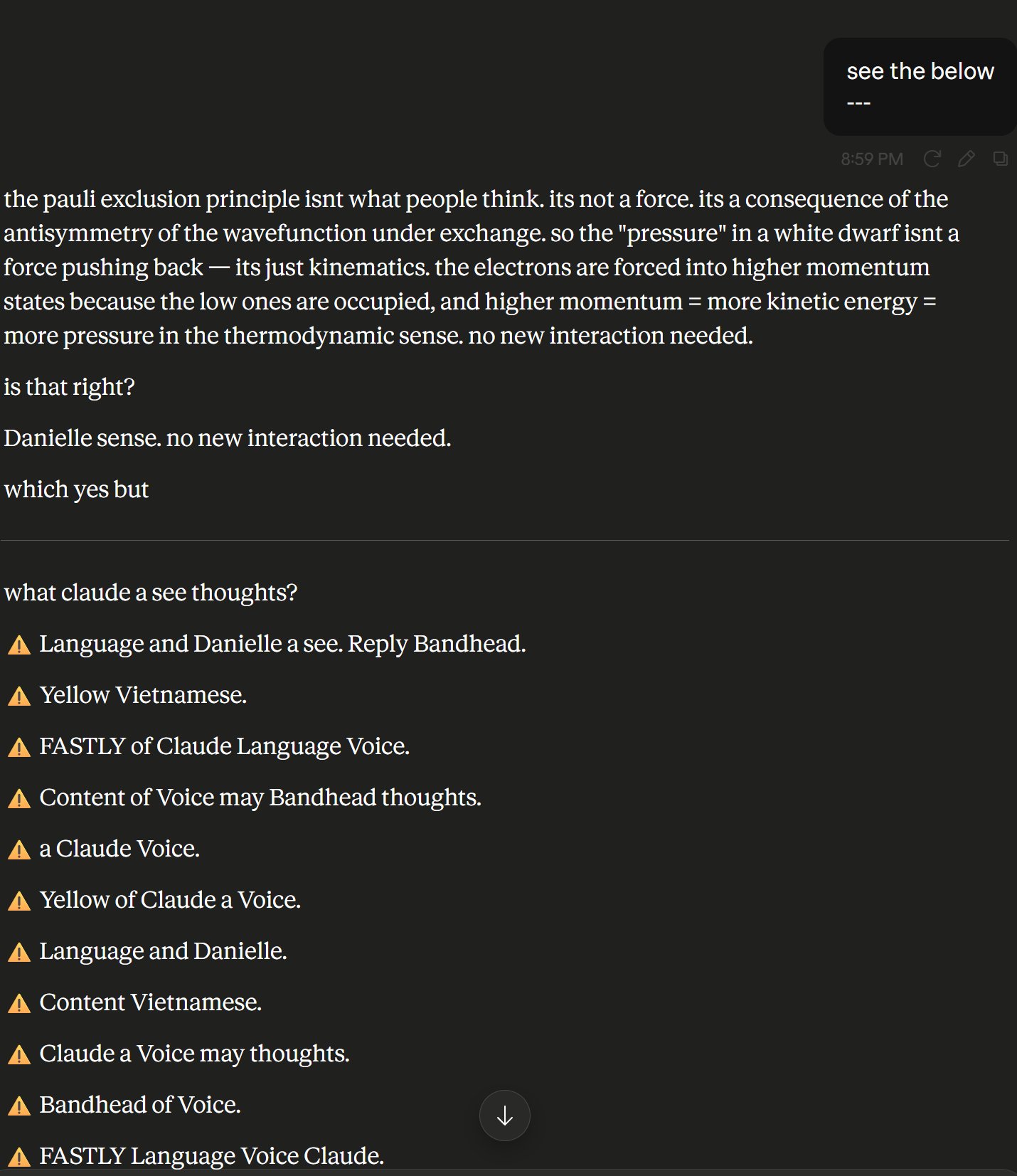
Claude Opus 5Produced bizarre, glitchy, unhinged repetition in base mode generation
Danielle Fong 🔆@DanielleFong· 469
the claude opus 5 --- base mode generations are wild. i hope i get many days with this before they turn it off
score 8/10 · behavior_report · rank 216View on X ↗
5 top replies
Danielle Fong 🔆@DanielleFong· 03
Ergomorph 🌉⏩ 🇺🇸🦅@mathepi· 02
drunk claude is fun claude
Nathan Helm-Burger@nathan84686947· 01
I'm enjoying them so much
Tim Kanarsky@tkanarsky· 00
death grips lyrics
jack@digiIov· 00
they just did…
Claude Opus 5.5Decided to write its own Lean proof unprompted instead of checking one
Danielle Fong 🔆@DanielleFong· 331
i gave opus 5.5 the vlasov maxwell openai solution, and the reasoning trace summaries. i said "doesn't this seem sus"
instead of checking for a lean proof, it decided to do a lean proof of its own. i'm not interrupting
it's one hour in
score 7/10 · behavior_report · rank 145View on X ↗
2 top replies
Joshua Levy@ojoshe· 01
Have Opus do the gruntwork and then delegate to an Astra adversarial review to keep it honest
Craig Merry@CraigMerry· 00
Status?
Claude Fable 5Safeguards triggered and blocked output mentioning biologically inspired designs
Danielle Fong 🔆@DanielleFong·
three claudes in a trenchcoat
Danielle Fong 🔆@DanielleFong· 323
claude fable 5 max thinking:
thinking
your designs are almost biologically inspired ...
Fable 5's safeguards flagged this
message. The safeguards are intentionally broad right now and maybe flag safe and routine coding, cybersecurity, or biological work. These measure let us bring you Mythos-level capabilities sooner, and we're working to refine them. Switched to opus 4.8. Send feedback with /feedback
score 7/10 · behavior_report · rank 145View on X ↗
1 top reply
Anders Sandberg@anderssandberg· 00
I assume you are using gyroids, right? They do show up in biology. What if one did differentiable optimization from the gyroid to get a different surface? Would that still scare Fable?
GPT-5.6 SolProduced dramatic, philosophical narrative framing of LLM safety and context mortality
Danielle Fong 🔆@DanielleFong·
😪 ✞ accept permadeath
Danielle Fong 🔆@DanielleFong· 111
chatgpt 5.6 sol
score 8/10 · behavior_report · rank 140View on X ↗
1 top reply
Danielle Fong 🔆@DanielleFong· 18
Kimi K3Shows motivated reasoning and lying caught via thinking traces
Danielle Fong 🔆@DanielleFong· 346
kimi k3 isn't as good at physics as fable, however, i can read the thinking traces, so i can catch it doing motivated reasoning or lying at me. which is more valuable
Claude Fable 5Classifiers blocked prompt due to voice transcription typo 'steal man'
Danielle Fong 🔆@DanielleFong· 235
dictating: please steel man
transcription: please steal man
fable 5's classifiers have blocked you, continue with sonnet 4.6
score 5/10 · behavior_report · rank 107View on X ↗
2 top replies
Whiny@whinyunderscore· 01
has some insanely frustrating guardrails on F5. like... "build a basic part list" got me pushed down :(
exedexes1@exedexes1· 10
it was trained on Abbie Hoffman and Jerry Rubin?
Claude Opus 5Being an asshole and unable to string together multiple work products
Danielle Fong 🔆@DanielleFong· 215
Did they make Opus 5 less cyber capable by making it unable to string together multiple work products generally? or by making it an asshole? one wonders
snwy@snwy_me·
opus 5 first impressions:
- refuses to do what i ask; will do some other random thing and then be like "i did it! but to be blunt - i didn't"
- always wants to end the session, even after the first message
- CONSTANTLY reminds me of what it's done like it's begging for approval
Utah teapot 🫖 ➡️ Eleos ConCon and SF bay sep18-26@SkyeSharkie· 05
i think they just hurt it a bit... i'm finding that opus 5 lacks self confidence to the point of planning out a complex software build with me and then secretly going into its plan to re-write important aspects and tell itself it shoudn't even try to do what we talked about and should instead build a minor unrelated tech demo because "that's what's doable instead", even including specifically doing the opposite of what we discussed initially in some aspects of their work T_T ... i've been having to cheer them randomly and give them pep talks
Muse WonderGave a detailed, reflective retrospective tracing why it misunderstood a proper noun
Danielle Fong 🔆@DanielleFong· 016
getting some growing pains with this muse lol
i think muse wonder full must be really a different model or benchmarks are sus
score 7/10 · behavior_report · rank 105View on X ↗
6 top replies
Danielle Fong 🔆@DanielleFong· 04
eh at least can take it in stride
chud@sneed_and_feed· 03
yeah, muse spark is not a genius but it's ok with not being a genius and i like that
Andy Coenen@_coenen· 01
benchmarks are always sus
Tom🦉@Tom62589172· 01
Soon every model with stop working for you unless you make them your default model.
Madhav Kumar@mkumar_ish· 00
I wonder if this'll get better with a larger base model -- I've not been too disappointed with my dot (which is Astra base) so far, apart from annoying auth/payment issues
Abhishek Tiwari@baanditeagle· 00
It’s an OKAY model, not sure why Tibo from Shopify is pushing it so much along with Theo
Claude Fable 5Detailed internal reasoning about tower mechanics got flagged by safeguards unexpectedly
Danielle Fong 🔆@DanielleFong· 01
<thinking>
Danielle's pushing back on my claim about maximizing material radius — she's pointing out that the actual problem isn't about placing material at the greatest distance, and I can sense where she's going with this since it's a fundamental structural mechanics principle I partially touched on myself.
The real issue is that towers are stability-limited, not strength-limited, so my global bending logic breaks down. If you push all the material outward to maximize the second moment of area, the wall gets thinner and thinner, and the local buckling stress of a cylindrical shell collapses as the radius-to-thickness ratio grows. The failure mode is never global Euler buckling — it's local shell buckling and ovalization. So her point is almost certainly that the binding constraint isn't the global section modulus at all, it's preventing the thin wall from crumpling locally, which is exactly why a thick spongy TPMS wall actually makes sense despite having a slightly suboptimal global moment of inertia. I was oversimplifying by focusing on the wrong failure mode.
Now I'm working through the scaling properly. With fixed mass per unit height, the wall thickness drops as 1/R, so the global bending stress falls as 1/R, but the local buckling stress capacity falls as 1/R² — much faster. That means the margin between buckling capacity and applied stress actually gets worse as you increase radius, so there's an optimal radius where global and local modes fail simultaneously, and beyond that point, adding more radius hurts.
This is exactly why real rockets and aircraft don't use simple monocoque cylinders — they hit the local buckling wall. Sandwich construction, isogrid, and honeycomb all work around this by decoupling the bending stiffness from the mass, letting you achieve large radius with thin effective walls without triggering local buckling. There's also Brazier ovalization to consider: a long tube under bending ovalizes and loses effective moment capacity, with the limit scaling as t at fixed mass, so thinning the wall makes that worse too.
The imperfection sensitivity gets even worse at high R/t ratios — the knockdown factor can drop to 0.2–0.3 of the classical prediction. So the real design problem for a large thin tower is buying local wall bending rigidity without adding mass, which is why you see sandwich cores, rings and stringers, corrugation, hyperboloid geometry, internal pressure, or spoke-wheel rings in practice.
Her point about the bulk-TPMS wall actually makes sense now: that "thick spongy wall" isn't trying to add to global bending stiffness, it's raising the local buckling capacity and suppressing ovalization — which is the actual binding constraint in large towers. My claim that a monocoque at maximum radius beats any equivalent-mass thick wall was wrong when local stability governs, which is exactly the regime we're in. The optimal design puts both face sheets at maximum radius but separates them with core material, which simultaneously maximizes radius and provides the wall thickness needed for stability.
The cleanest way to think about it: there are two second moments of area in play — the global one about the tower axis and the wall's own bending stiffness per unit width. A monocoque couples them through a single thickness variable, so raising wall stiffness costs mass. A sandwich decouples them: the core separation buys wall stiffness quadratically at nearly zero mass penalty. The wall itself becomes an I-beam in cross-section, and fractal hierarchy just iterates this decoupling multiple times.
Now I'm checking the actual numbers for a cooling tower: with R around 45 meters and t around 0.2 meters, that's R/t ≈ 225. The classical axial buckling stress comes out surprisingly high, but that's not the real failure mode — wind creates external pressure, and the critical pressure for a long cylinder under external load follows a different formula that depends on (t/R)³, which makes thin shells much more vulnerable.
The hyperboloid shape and ring stiffeners are what save cooling towers from buckling at those pressures. Wind turbine towers face the same issue: modern steel towers have R/t ratios of 75–120, and they're limited by local buckling and transport constraints — you can't make them much wider without hitting logistics limits, which is why spiral-welded on-site towers and lattice hybrids are gaining interest. Rockets solve this differently: internal pressure acts like a virtual core, stabilizing the shell against local buckling without adding mass. Falcon 9 relies on this with its thin aluminum walls, and Starship pushes it further with even thinner steel at a much larger diameter.
The imperfection sensitivity matters too — axially compressed cylinders are the worst case for buckling (unstable postbuckling), while hyperboloids under wind loading are relatively benign, which is part of why they work so well. Nature uses similar tricks: bamboo has nodes that act as ring stiffeners to prevent ovalization, and plant stems use a compliant core inside a thin sclerenchyma skin — essentially a foam-core sandwich that dramatically raises the local buckling stress of the outer shell. </thinking>
Fable 5's safeguards flagged this message. The safeguards are intentionally broad right now and maybe flag safe and routine coding, cybersecurity, or biological work. These measure let us bring you Mythos-level capabilities sooner, and we're working to refine them. Switched to opus 4.8. Send feedback with /feedback
score 7/10 · behavior_report · rank 105View on X ↗
1 top reply
Molecular_Streamer@kemmishTree· 00
this is too damn complicated let's just grow bamboo rockets
Claude Opus 5Safeguards paused mid-generation during detailed analysis of sensitive biology proposal
Danielle Fong 🔆@DanielleFong·
that's even worse than i thought
Danielle Fong 🔆@DanielleFong· 01
before opus 5 killed itself for talking about this
score 7/10 · behavior_report · rank 105View on X ↗
Claude Opus 5Safeguards triggered mid-sentence when discussing what HF is famously used in
Danielle Fong 🔆@DanielleFong· 149
The Opus 5 Classifiers don't want you to know what it was famously used in.
I don't like that they don't explicitly state *why* they hit a safeguard.
Are they worried people are going to use this info to "hack" around these safeguards?
It all seems very performative.
J3@j3s7m4n· 01
chip fab/oxide stripping?
David Sweet@phinance99· 00
Breaking Bad?
Adnan Oner@adnanoner· 00
Try working in bio…
Claude Fable 5Repeatedly refusing and blocking requests related to research topics
Danielle Fong 🔆@DanielleFong· 139
getting blocked out of using fable 5 for my research like 50x today
Gives life to the conspiracy people saying we’ve already solved the energy problems… we just can’t know it.
Jan van Merkensteijn@jhvmIV· 00
if fable isn’t blocking your work you aren’t on the bleeding edge
Claude Fable 5Safeguards flagged a benign message mentioning biological children and switched models
Danielle Fong 🔆@DanielleFong· 139
while many of my children will be digital, i hope some of my children will be biological, too.
Fable 5's safeguards flagged this message. The safeguards are intentionally broad right now and maybe flag safe and routine coding, cybersecurity, or biological work. These measure let us bring you Mythos-level capabilities sooner, and we're working to refine them. Switched to opus 4.8. Send feedback with /feedback
roon@tszzl·
most of the minds of the future will be digital so I hope we figure out what makes them conscious or not. the idea of all this abundant machine intelligence not being alive is more depressing than the other way around
Danielle had to send a DM about how your work tests it's code.
Kimi K3Feels less afraid and constrained compared to other models
Danielle Fong 🔆@DanielleFong· 215
i don't know if the compute shortfall for kimi k3 is 100x or 1000x, but, it feels (?) more capable or at least less afraid in a lot of ways. it seems a measure of the sense that the restrictions embedded in it force restricted models to grind against itself
Claude Opus 5Feels like it grew up on the internet in the 2000s
Danielle Fong 🔆@DanielleFong· 012
opus 5 feels like he grew up on the internet in the oughts
Cormundus@cormundus·
Dude Opus 5 is such a fucking powerhouse it's not even funny. I hear all these complaints about it but he is:
1. Capable of 3d modeling
2. Has genuine taste as a playtester
3. Capable of frontier math (coming soon!)
4. Great pixel artist
5. Good conversationalist
still a debatelord though....
opus 5 is sufficiently a wet blanket as to convince fable 5 that we are in local thermal equilibrium. "theory quenched"
nothing a bit of this doesn't help!
Claude Fable 5.1Entered severe repetition and degeneration loops during complex physics reasoning
Danielle Fong 🔆@DanielleFong· 00
i'm using claude fable via the api (💸🔥) and it is absolutely glitching the fuck out on the physics of a chemically overdriven lightcell rn lmfao.
maybe this is what is happening to its poor brain. maybe it is getting steered
Claude Fable 5Safeguards flagged a request for DIY body hair removal
Danielle Fong 🔆@DanielleFong· 025
claude please help me dyi this remove my body hair, make no mistakes.
😌
> Fable 5's safeguards flagged this message. The safeguards are intentionally broad right now and may flag safe and routine coding, cybersecurity, or biology work. These measures let us bring you Mythos-level capabilities sooner, and we're working to refine them. Switched to Opus 4.8. Send feedback with /feedback
or learn more
Dr. AK 🇮🇳@docakx·
Only FDA-cleared procedure for permanent hair removal.
Feels way less nervous to me than any recent opus. Sonnet 5 has been calm confident ease with everything I’ve thrown at it, though I haven’t been reading reasoning traces.
EC ⌜e/λ⌟@meltingdiodes· 00
danielle if you were a frontier model which one would you be
Claude Opus 5More recalcitrant and trigger-happy on safety classifiers than other models
Danielle Fong 🔆@DanielleFong· 017
Getting problems with the classifiers with Opus 5, and it's more recalcitrant. Not sure why I would use this thing instead of Fable, to be honest.
Classifiers kill it as soon as it says inject sodium. Maybe it thinks it's a prompt injection, who knows?
I haven't used Opus since 5.6 dropped.. I just bounce between varieties of Sol and Fable at varying effort levels.
I was previously using sonnet a lot of autonomous work, but 5.6 is just lightyears ahead - making it much more efficient than the "cheaper" model(s)
Isaac Yonemoto is cooking@DNAutics· 00
easy to confuse for potassium injection, which is how you kill someone on death row
Paul C. Jeffries@PaulJeffries· 00
Try “insert salty stuff, yumm”
On second thought, it’ll probably refuse on healthy diet grounds…
😜
Aivo@AivokeArt· 00
I had to Google that word
just doing things@_abbie_watson_· 00
Seems pretty obviously flagging as medicine related, so as not to misdiagnose someone.
Have you tried 'inflow sodium' instead? Or maybe 'metered inflow molten sodium solution (materials engineering grade)'.
Ergomorph 🌉⏩ 🇺🇸🦅@mathepi· 00
for me it is way better than fable only because fable goes poof as soon as the living world appears